Tag: electrical insulators

  • Line post insulators key in Colombia’s grid revamp

    Power grid expansion efforts Colombia

    Colombia has taken important advances toward renewable energy adoption by accelerating its transformation to a greener, more robust electrical grid. This is contingent on the country solving significant hurdles while exploiting its natural resources. Colombia has abundant in renewable energy sources such as hydropower, wind, sun, biomass, and geothermal. The country can proceed quickly by expediting transmission projects, easing permitting for solar and wind, including storage to balance renewables, and encouraging public-private partnerships. Colombia plans to boost its renewable energy share from less than 5% now to at least 30% by 2030. Integrating significant amounts of variable renewables necessitates grid modernization, adaptable backup systems, and smart policies to assure stability and reliability. This can also help strengthen cross-border connections through regional electricity markets. Line post insulators ensure electrical insulation, mechanical support, and grid reliability.

    High-quality line post insulators help to preserve system stability and efficiency, allowing for an increase in renewable energy share. They protect against leakage currents and short circuits by isolating live conductors from grounded structures. They ensure they can endure lightning strikes and switching surges in Colombia’s tropical climate. Line post insulators provide structural strength to support power lines in heavy winds. They are made of polymer or porcelain materials that are resistant to UV radiation, humidity, pollutants, strong rains, and landslides. In renewable energy, smart grid-ready insulators can incorporate sensors to track line temperature and corrosion. Lightweight polymer insulators are easier to install in off-grid solar and wind microgrid systems. They also lessen the need for maintenance in Colombia’s remote locations.

    Line post insulators for Colombia’s power grid development.

    Using durable and resilient components is critical in extending Colombia’s power grid to meet the growing percentage of renewable energy. Line post insulators provide mechanical stability and electrical insulation for overhead distribution and transmission systems. They contribute to the integration of clean energy sources as well as the modernization of an old grid. They may combine mechanical strength with high-voltage insulation, making them an essential component of a safer, more efficient, and renewable-ready power network. The following are the functions of line post insulators in Colombia’s power grid growth.
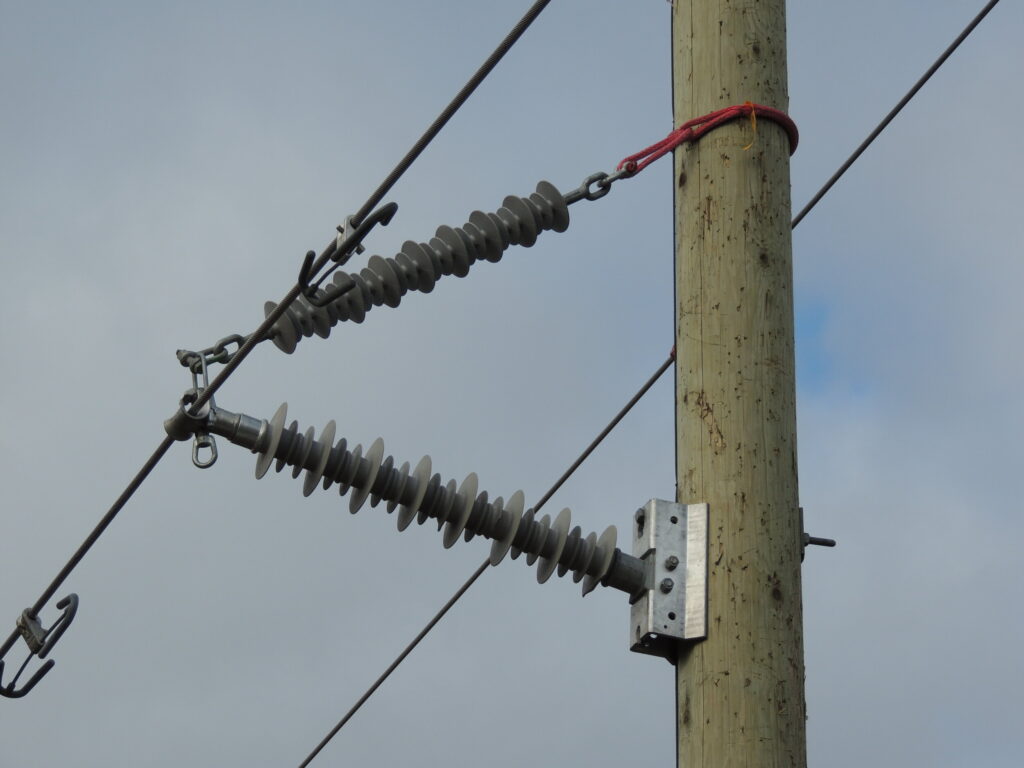
    Line post insulator help resist environmental forces
    • Electrical insulation in high-voltage environments – line post insulators are able to electrically isolate live conductors from grounded structures. They ensure safe, uninterrupted power transmission.
    • Mechanical support and conductor stability – the insulators provide rigid mechanical support to conductors. Line post insulators withstand heavy conductor loads and tension, resist environmental forces, and maintain conductor alignment.
    • Adaptability to harsh environmental conditions – line post insulators are able to resist high humidity, UV exposure, and pollution. They are from materials that provide resistance to contamination, minimal maintenance needs, and high dielectric strength.
    • Support for compact and urban installations – line post insulators allow for compact pole designs, versatile mounting configurations, and safe clearances.
    • Enabling renewable integration and grid flexibility – rooftop solar, microgrids, and hybrid systems feed into the national grid. Line post insulators ensure reliability in bidirectional power flows, support feeder reconfigurations, and enhance the safety and lifespan of upgraded lines.

    The implications of modernizing Colombia’s electrical grid for renewable energy

    Upgrading the national electricity infrastructure is critical to unlocking Colombia’s renewable energy transition capabilities. An outmoded, centralized, and hydro-dependent infrastructure is insufficient to please the needs of a sustainable, inclusive, and climate-resilient energy future. The implications of modernizing Colombia’s electrical grid include:
    1. Increased renewable energy integration – upgrading the grid leads to more variable and distributed energy sources like solar and wind. Modern transmission and distribution systems helps handle intermittency, leading to increased energy generation.
    2. Reduced carbon emissions – a modernized grid supports the shift from fossil fuels and reduces reliance on climate-vulnerable hydropower.
    3. Improved energy access and equity – grid upgrades allow Colombia to extend reliable electricity to rural and underserved regions. Microgrids and mini-grid solutions are workable in off-grid areas.
    4. Enhanced grid reliability and efficiency – outdated infrastructure contributes to energy losses, frequent blackouts, and high maintenance costs. Upgrades lead to reduced technical losses in transmission and distribution. It also leads to more reliable service and real-time monitoring and automation for predictive maintenance and grid optimization.
    5. Attraction of investments – an upgraded grid helps the country attract foreign and domestic investors seeking clean energy opportunities. Also, manufacturers and suppliers of grid components such as insulators, arresters, and clamps are also attracted to Colombia.

  • Shackle Insulators: Powering Argentina’s Lithium Boom

    lithium supports the advancements of electric vehicles and energy storage

    Argentina plays a crucial role in the lithium market, possessing some of the largest lithium reserves globally. There is growing demand stemming from electric vehicles, energy storage, and renewable technologies. Lithium in Argentina is primarily sourced from salt flats found in Salar del Hombre Muerto, Salar de Olaroz-Cauchari, and Salar de Atacama. Vale S.A. has been investigating lithium prospects to aid the EV supply chain. It could use its financial resources and technical knowledge to penetrate Argentina’s lithium market via joint ventures. However, Lithium Argentina is concentrating on lithium extraction and production from brine sources. The nation has been promoting overseas investments to enhance lithium production. The firm provides lithium carbonate to worldwide markets for electric vehicle producers. Employing shackle insulators enables power distribution cables to traverse the landscape.

    Shackle insulators offer both mechanical strength and electrical insulation for poles and towers. This aids in avoiding short circuits or energy loss from contact with grounded structures. Shackle insulators are constructed from porcelain or polymer materials that offer excellent corrosion resistance. These resources assist in guaranteeing a constant power supply to extraction machinery and reduced upkeep in remote locations. Premium shackle insulators offer tough, corrosion-proof insulation that endures severe environmental conditions. This guarantees a continuous energy supply for lithium projects powered by both traditional and renewable sources. Lithium initiatives are utilizing renewable energies such as solar power to cut ecological effects. Shackle insulators help maintain grid stability in hybrid energy systems.

    The roles of shackle insulators in Argentina’s lithium extraction and production

    Shackle insulators ensure the reliability and safety of electrical infrastructure in harsh environments. The use of shackle insulators helps maintain an uninterrupted power supply and efficiency in Argentina’s lithium mining and processing operations. Their durability and design make them ideal for the challenging environments of lithium-rich salt flats. Here are the functions of shackle insulators in lithium extraction and production in Argentina.

    Shackle insulator ensures safety of electrical infrastructure
    1. Supporting overhead power lines—Argentina’s lithium extraction sites are mostly located in remote regions. High-performing shackle insulators secure and insulate overhead power lines. These lines supply electricity to mining facilities, processing plants, and pumping systems.
    2. Electrical insulation in high-voltage applications—shackle insulators prevent electrical leakage and short circuits. This is done by providing insulation between conductors and support structures. This makes them ideal for lithium production, which involves electrically powered machinery, pumps for brine extraction, and electrolysis processes.
    3. Corrosion resistance—porcelain shackle insulators are resistant to salt corrosion to ensure durability. This is vital as Argentina’s lithium operations use brine methods that expose infrastructure to highly corrosive salt environments.
    4. Renewable energy integration—shackle insulators serve in transmission lines connecting renewable energy plants to lithium processing facilities. The increased adoption of solar and wind power helps reduce carbon emission footprints.
    5. Safety and reliability—high-quality shackle insulators withstand dust, storms, UV radiation, and thermal stress. They help reduce power disruptions that could halt lithium production.

    Extraction and production of lithium in Argentina’s energy industry

    Argentina is essential to the global clean energy transition via lithium production and extraction. Lithium plays an essential role in battery storage technology, affecting the energy industry, the economy, and renewable energy goals. Argentina needs to build local refining skills, guarantee environmental sustainability, and draw in strategic alliances in battery and energy storage. The extraction of lithium encounters difficulties like issues of sustainability and regulation as well as political instability. Utilizing shackle insulators guarantees effectiveness in lithium mining and processing activities. The roles of lithium extraction and production in Argentina’s energy sector are as follows.

    • Assisting renewable energy storage—lithium-ion batteries keep energy produced by solar and wind energy. Domestic lithium production may assist Argentina in creating grid-scale battery storage systems to incorporate renewable energy.
    • Bolstering Argentina’s electric vehicle sector—lithium extraction enables Argentina to enhance EV manufacturing and usage. The lithium sector has the potential to reduce battery prices, thereby making electric vehicles more accessible for the local market.
    • Export earnings and economic expansion—lithium extraction has emerged as a key export industry promoting foreign direct investment. This may additionally aid in increasing production and drawing in international battery producers.
    • Industrial advancement—lithium extraction and processing—creates employment opportunities across different provinces. This promotes technological advancements resulting in the emergence of new sectors in battery production.
    • Strategic placement in the worldwide energy market—Argentina is establishing itself as a crucial provider of energy transition technologies. Nations that invest in clean energy are ensuring lithium supply chains.