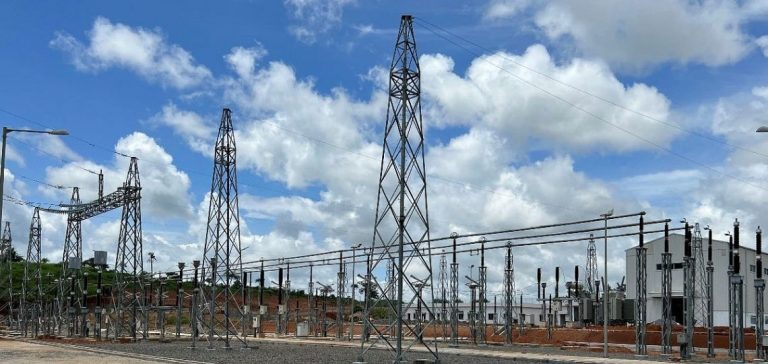
Argentina’s electrical system development and improvement is critical for increasing wind and solar capacity and converting renewable potential into reliable national supply. High winds are concentrated in Patagonia, and solar capacity is increasing in the central-western regions. The country is investing in new 132, 220, and 500 kV lines. The project expands evacuation capacity, lowers losses, and improves interconnectivity. Upgrades in substations include higher-capacity transformers, updated protection and control systems, and digital monitoring. The upgrades enable the infrastructure to handle varying electricity flows from wind and solar installations. They do so while keeping voltage and frequency stable. These new advancements cause the usage of durable hardware components, such as preformed deadend clamps.
Conductors and overhead ground wires are terminated and anchored by preformed deadend clamps that spiral onto the cable. They provide a dispersed and uniform grip across the length of the conductor without crushing it. The compressive grid decreases stress concentrations in individual conductor strands. The dead-end clamps work with a variety of conductor diameters and kinds, eliminating the need for bespoke engineering for each tower attachment. The design ensures that the conductor’s integrity is not jeopardized while retaining its tensile strength.
Technical specifications for prefabricated deadends used in grid expansion infrastructure
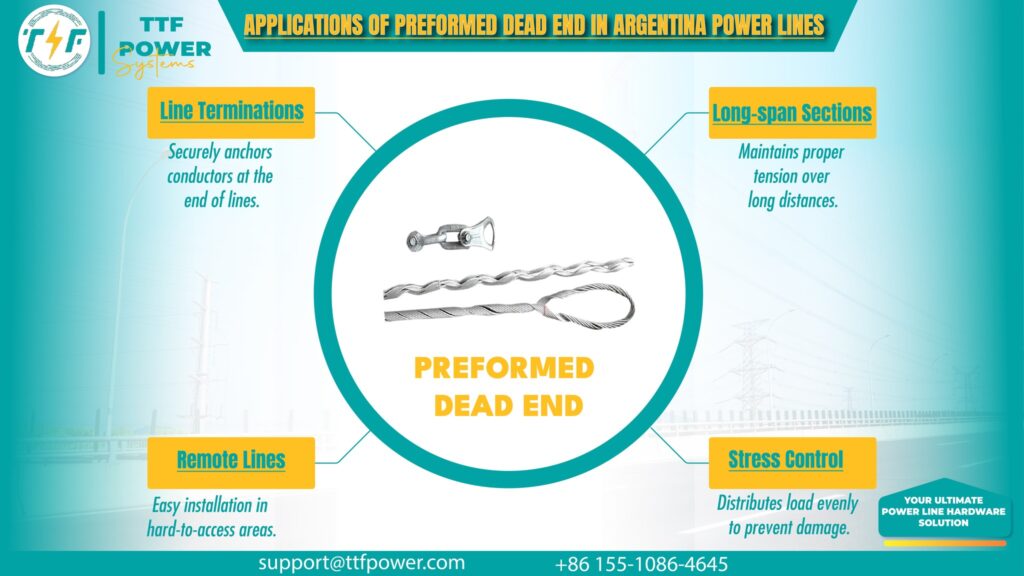
Preformed deadend clamps help meet rigorous mechanical, electrical, and environmental specifications. Deadends are used on distribution and sub-transmission lines because they are reliable, easy to install, and provide conductor protection. Deadend clamps are prefabricated and used to stop conductors at deadend buildings, angle points, and sectioning places. Mechanical standards, conductor compatibility, material and corrosion resistance, and electrical and thermal performance are all important considerations. Adherence to these requirements facilitates the integration of expanding renewable capacity while maintaining system performance. They also value mechanical strength, conductor compatibility, corrosion resistance, and electrical continuity.
Performed deadend clamps in Argentina’s grid expansion
Preformed deadend clamps serve mechanical and operational purposes in Argentina’s grid expansion program. They are critical to the dependability, longevity, and speed of new transmission and sub-transmission deployments. Preformed deadend clamps can securely anchor conductors, distribute mechanical stress, and handle fluctuating loads. The following are the functions of prefabricated deadend clamps in grid expansion in Argentina.
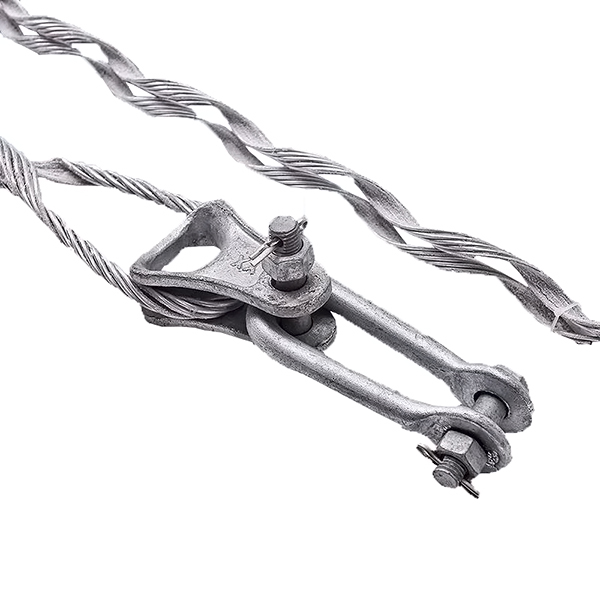
- Secure conductor termination—the preformed dead-end clamps terminate conductors at dead-end structures, section points, and line ends. They transfer the full tensile load of the conductor to the supporting structure. Deadend clamps ensure stable line anchoring where renewable generation needs new line extensions.
- Uniform stress distribution and conductor protection—the deadend clamps use helically wrapped rods that distribute mechanical stress along the conductor length. They help reduce localized pressure and prevent strand damage, fretting, or fatigue.
- Performance under variable loading conditions—preformed deadend clamps accommodate thermal cycling and fluctuating power flows without loss of grip or mechanical degradation. They maintain consistent tension and reduce the risk of slippage under cyclic loading.
- Electrical continuity and system stability—the deadend clamps maintain electrical continuity along the conductor. They provide a stable conductive interface that supports normal operating currents and withstands fault conditions.
The technical and operational significance of Argentina’s system expansion for renewable energy integration
Argentina’s grid upgrades alter how the power system runs, allowing for more renewable penetration. It does so while retaining dependability, efficiency, and system security. Increasing transmission capacity boosts system stability, decreases curtailment, and enhances operational flexibility. Grid expansion is the foundation of Argentina’s renewable energy integration strategy. Here is the significance of grid expansion in Argentina.
- Increased transmission and evacuation capacity—new high-voltage and sub-transmission lines expand the grid’s ability to evacuate power from renewable-rich regions to load centers. This addresses congestion constraints that limit the output of wind and solar plants.
- Voltage and frequency stability enhancements – renewable generation introduces variability and reduced system inertia. Grid expansion combines with upgraded substations and modern protection schemes to improve voltage regulation and frequency control.
- Compatibility with modern conductors and hardware—grid upgrades enable the use of higher-capacity and higher-temperature conductors, advanced line fittings, and improved insulation systems. These improvements allow more power to flow through each line without compromising thermal limits.
- Improved fault management and protection coordination—expanded networks use modern protection, automation, and monitoring technologies. The systems enhance fault detection, isolation, and recovery. This is crucial in a grid with a high share of inverter-based renewable generation.